Katsudon With a Crisp Cutlet and Egg That Stays Silky
Jump to recipe ↓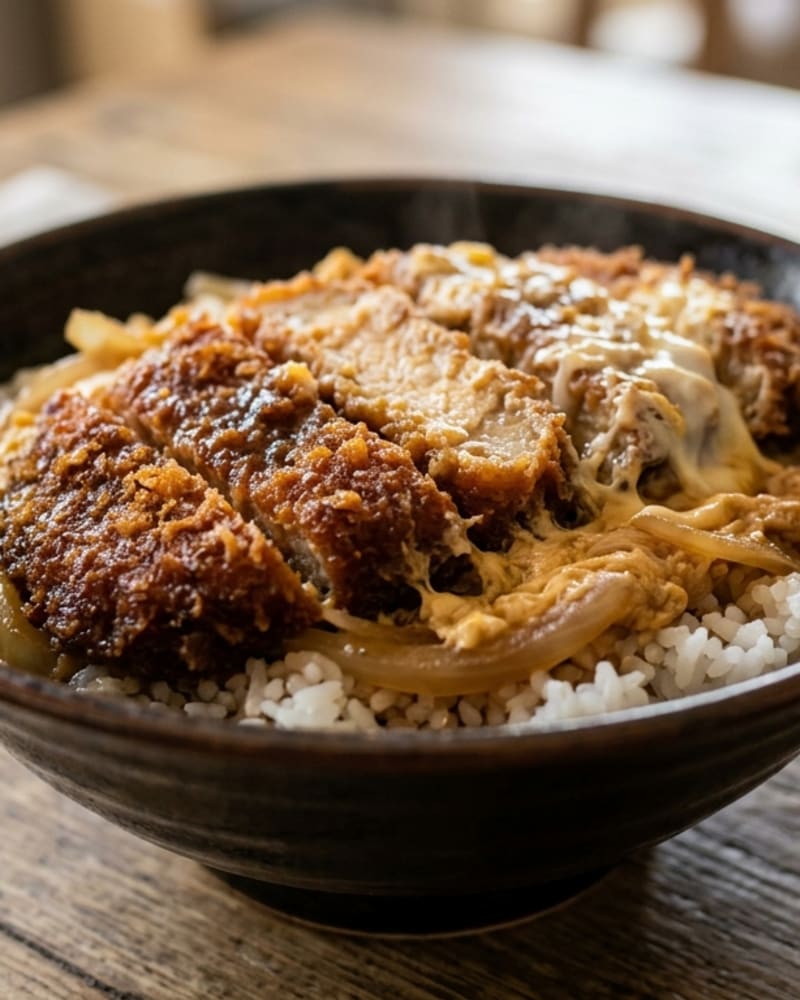
It is 6:30 on a Wednesday, the oven is already doing the heavy lifting, and the freezer bag of breaded chicken is about to look like it came with a reservation. This katsudon recipe takes 39 minutes, most of it hands-off, and the only thing you are in charge of is not overcooking the egg. Nobody has to know where the cutlet started. We will keep that between us.
Crunch, silk, and a sauce that tastes like you took the long way.
Katsudon is a Japanese rice bowl: a breaded cutlet, sweet onions and soft egg in a dashi, soy and mirin sauce, all spooned over rice. Here the cutlets come from frozen breaded chicken breasts baked until crisp, which means the dish needs no frying and no deep pot of oil. While they bake, the sauce comes together in one skillet, and the whole bowl lands on rice you warmed from a pouch.
What you need
- 4 frozen breaded chicken breasts
- 1 yellow onion
- 4 eggs
- 4 microwavable short-grain rice pouches
- 1 cups dashi
- 4 tbsp soy sauce
- 3 tbsp mirin
- 1 tbsp sugar
- 3 green onions
- 1 tbsp vegetable oil
- ¼ tsp salt
- ¼ tsp black pepper
How to make it
- Thinly slice 1 yellow onion and 3 green onions, about 5 minutes. Bake 4 frozen breaded chicken breasts according to package directions until crisp, usually 20 to 25 minutes at 400 F.
- Warm 4 microwavable short-grain rice pouches as directed on the packages and keep covered.
- In a measuring cup stir together 1 cup dashi, 4 tbsp soy sauce, 3 tbsp mirin, and 1 tbsp sugar.
- Heat 1 tbsp vegetable oil in a large skillet over medium heat. Add the sliced yellow onion and cook 4 to 5 minutes until soft and lightly golden.
- Pour the dashi mixture over the onions and bring to a gentle simmer for 2 minutes. Slice the baked cutlets into strips and nestle them into the sauce.
- Lightly beat 4 eggs with 0.25 tsp salt and 0.25 tsp black pepper. Pour the eggs evenly over the cutlets, cover, and cook 1 to 2 minutes until the eggs are just set but still soft.
- Divide the hot rice among 4 bowls, spoon the cutlet, onion, and egg mixture over the top, and finish with the sliced green onions.
Notes
Cooked leftovers keep three to four days refrigerated, per USDA FSIS. The cutlet is softer on day two because it has sat in sauce and egg, so think of the leftover as a different, cozier dish. Reheat gently in a skillet with a splash of water so the egg does not toughen.
We would not freeze the finished bowl. Egg that has been set and then thawed turns grainy, and the breading has already given up most of its crunch by then.
The bake time is on the package, and the method says it usually runs 20 to 25 minutes at 400 F. Use the pack as your guide. Chicken is done at 165 F in the thickest part, so if you are unsure, check with a thermometer before slicing.
Slice the baked cutlets into strips and nestle them into the sauce, rather than submerging them. The tops stay a little crisp while the bottoms drink the sauce, which gives you two textures in one forkful. That is the entire flirtation of the dish: crunch on top, silk underneath.
Season the egg with the salt and black pepper the method calls for, and give it a light beat. You want streaks of white and yolk, not a uniform yellow, because streaks make the soft-set layer look rich and a little lazy in the best way.
The best part of a katsudon recipe built on frozen cutlets is the time it gives back. The oven does the crisping while you slice onions and stir the sauce, so you are not standing over hot oil.
Swaps that actually work
The breaded chicken cutlet is the point. It is the crisp thing the whole bowl leans on, so keep something breaded and sliceable. Everything else can move.
If you have a pork cutlet or tonkatsu from another night, it slots in without a fuss and is closer to the classic pork version of the dish. You can also use bakery-style breaded chicken cutlets from the refrigerated aisle, following their directions.
The dashi can come from instant granules or a packet. Chicken broth in a pinch works but loses the faint smoky sea note that sets this bowl apart. If you use broth, taste before adding the full soy sauce, because broth brings its own salt.
No mirin? A splash of dry sherry or rice vinegar plus a pinch more sugar gets you into the same neighborhood. It will taste a touch different, and the bowl will still be good.
Short-grain rice from a microwavable pouch is the speed move, and the method uses it. If you cook your own, use short-grain so it clumps softly under the sauce.
If you need to adapt this katsudon recipe for a smaller table, halve the sauce and egg but keep the full pan size. A crowded pan cooks the egg unevenly, and a roomy one gives you that soft, even layer.
If it goes wrong
The egg is rubbery or dry. It cooked too long. Next time, pull the pan when the top still looks a little wet. If it is already firm, spoon extra sauce over the rice to bring moisture back.
The cutlet is soggy. It sat in the sauce too long, or it went in before the sauce had simmered. Nestle the strips in at the last minute, and put them on top of the egg bowl rather than burying them.
The sauce is too sweet or too salty. The dashi was stronger than expected, or the soy sauce brand runs salty. Thin it with a splash of water, then adjust with a pinch of sugar or a few drops of soy. Taste a spoonful on rice, not on its own.
The onions are pale and raw. They need the 4 to 5 minutes the method gives them, until soft and lightly golden. Cut them thinner if your slices are thick.
What to serve with it
The default is a bowl of rice with everything on top, and that is a full dinner.
The better version adds a small side of pickled vegetables or a quick cabbage slaw. Something sharp and cold cuts through the sweet egg and makes the second helping feel earned. A cup of miso soup alongside turns it into a proper meal.
The thing in the fridge that lifts it is a few thin green onion rings on top, which the method already includes, and a pinch of sesame seeds if you have them.
It works as lunch the next day. Reheat the topping separately from the rice and the egg stays gentler.
To make this katsudon recipe feel like a restaurant meal, serve the bowls with a cold side and something warm to sip. The contrast between hot rice and a crunchy, sharp pickle goes a long way.
Why this one earns its place
You asked for comfort food after a long day. This is the one that does not make you pick between crunchy and soft. It is a date that shows up on time, looks good in the low light, and does not ask for a second round of small talk.
A katsudon recipe that works from the freezer and a pantry shelf is useful on the nights you are tired. It is hot, it is quick enough, and it does not ask you to fry anything.
Swipe it into your week and the agent can shop the breaded chicken, rice pouches, dashi and mirin for you, so all that is left is the pan.
If you want more in this neighborhood: Pork Tonkatsu, Chicken Katsu Curry, and Katsu Sando.
More like this: all Japanese recipes in Crave Corner.