Pepper Steak With Beef That Stays Tender and a Sauce That Clings
Jump to recipe ↓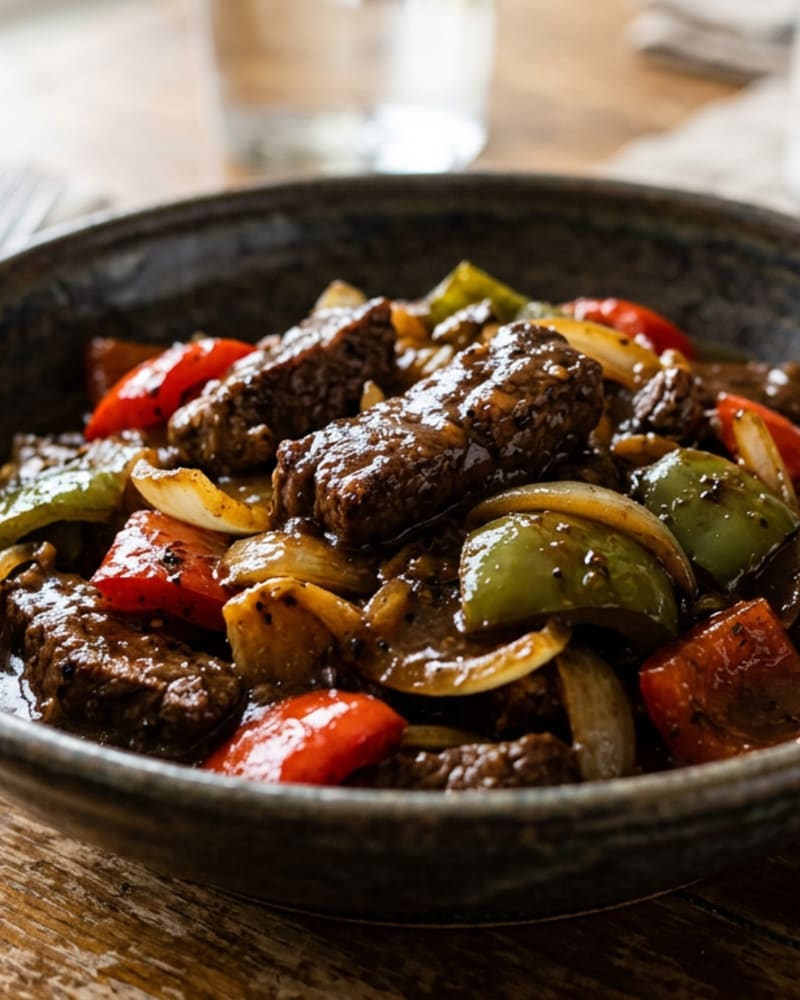
It is 7:05 on a Thursday and the delivery app is open in the other hand. Put it down. This pepper steak is 9 minutes of slicing and 6 at the stove, with the rice going on first, and there is no stranger on your porch holding a bag. You get the sizzle, the soy and the glossy peppers, and the only person who sees you in sweatpants is whoever you invite to the table.
Thin slices, a hot pan, and a cornstarch coat: that is the whole trick.
The dish is flank steak, bell peppers and onion, a quick soy sauce that thickens as it hits the pan, and rice underneath. Nothing simmers for an hour, nothing needs a special trip. The beef cooks in two or three minutes, the vegetables in four, and the sauce takes two more, so the work is all in the slicing and the heat of the pan.
What you need
- 1 lb flank steak, thinly sliced
- 3 bell peppers, sliced into strips
- 1 onion, sliced into strips
- 3 tbsp soy sauce
- 3 cloves garlic, minced
- 2 tsp cornstarch
- 2 tbsp vegetable oil
- 2 cups white rice, dry
- ¼ tsp salt
How to make it
- Slice the 1 lb flank steak thinly against the grain and toss with 1 tsp cornstarch.
- Slice the 3 bell peppers and 1 medium onion into strips and mince the 3 garlic cloves.
- Heat 1 tbsp vegetable oil in a wok or large skillet over high heat.
- Stir-fry the beef for 2 to 3 minutes until browned, then remove from the pan.
- Add the remaining 1 tbsp vegetable oil along with the peppers and onion and cook for 4 minutes.
- Return the beef to the pan and add the minced garlic along with the 3 tbsp soy sauce mixed with the remaining 1 tsp cornstarch and 1/4 cup water.
- Stir-fry for 2 minutes until the sauce thickens and coats everything.
- Serve immediately over the 2 cups dry white rice cooked according to package directions.
Notes
Cooked leftovers keep three to four days refrigerated, per USDA FSIS. Keep the rice and the pepper steak in separate containers, so the rice does not drink the sauce overnight and turn to paste.
Reheat it in a hot skillet for a minute or two rather than in a microwave if you can. The peppers lose a little snap either way, and a hot pan gets some of it back. It does not freeze as well as a braise would, because the peppers and onion go soft once thawed.
Slicing the flank is the step that decides how this turns out. Put the steak in the freezer for a short while before you cut it and it firms up enough to slice thin with a sharp knife. Look for the lines running along the muscle, which is the grain, and cut across them, not with them. Slices cut with the grain tend to stay chewy however well you cook them, and chewy is not the kind of commitment anyone signs up for.
Cooking the beef in one layer matters too. The method sears it for two to three minutes and takes it out, so it does not sit and steam while the vegetables cook. If your pan is small, do the beef in two rounds and keep the heat high.
The peppers go in for four minutes and no more. You want them softened but still bright and a little firm, because they finish cooking in the sauce for two minutes at the end.
On SwipeCart, the pepper steak card is the one you swipe right on when the takeout menu starts to feel like an ex you should stop texting. Your agent puts the flank, the peppers and the rice in the cart, and the evening belongs to you.
Swaps that actually work
The flank and the cornstarch are the point. Slice the steak thin, coat it, and sear it hot, and you get beef that holds its own against the sauce. Skip the coating and the strips are more likely to come out gray and tough.
Sirloin and skirt steak both work if flank is not at the store, sliced the same way. Skirt has a pronounced grain, so slice across it with care.
Bell peppers can be any mix: red, green, yellow or orange. The red and yellow are sweeter, the green has a sharper edge, and a mix of colors makes the pan look like you tried. Sliced mushrooms or a handful of snap peas can join the pan if the crisper needs clearing out.
Soy sauce can be low sodium or tamari, if that is what you have. Taste the sauce before you reach for the pinch of salt, because soy is salty enough that you may not need all of it.
Cornstarch can be potato starch or arrowroot, in the same amount. Flour is the swap that costs you the dish: it clouds the sauce and does not give the beef the same silky coat.
Noodles can stand in for the rice, if there is a packet in the cupboard. The sauce is a little thin for a heap of noodles, so toss them in the pan at the end for a few seconds and let them pick up what is left.
If it goes wrong
The beef is tough. It was cut with the grain, sliced too thick, or cooked past the point where it browned. Slice thin and across the grain next time, and take the beef out of the pan as soon as it is browned. It goes back in at the end and finishes in the sauce.
The sauce is thin. The cornstarch did not get a chance to cook. Keep stirring over high heat for the full two minutes, until the sauce turns glossy and clings to the spoon. If it is still loose, mix a small spoon of cornstarch into cold water and stir that in.
The peppers are soggy. Crowded pans make for clingy peppers, and soggy is what you get when nobody has room to breathe. The pan was crowded or the heat was low. Cook the vegetables over high heat and stop at four minutes. Next time, give them the whole pan to themselves.
It tastes flat. Taste the sauce, then add a pinch of salt or a splash more soy. A squeeze of lime at the table lifts it too.
What to serve with it
The default is white rice, which is what the recipe calls for, cooked according to the package while you slice.
The better version is a bowl of rice with a fried egg on top, runny, so the yolk joins the sauce. It turns a tidy dinner into a messy, better one.
The thing in the fridge that lifts it is sliced scallions or a spoon of chili crisp, if you have a jar. Both go on at the table and neither needs cooking.
It works as lunch the next day, packed in a container with the rice on one side. Reheat it in a hot skillet and you have a desk lunch with some dignity.
Why this one earns its place
You want takeout flavor and you do not want to wait for it. This pepper steak is the answer you give yourself at 7:05: one pan, one board, and the kind of dinner that looks like you had a plan. It does the work fast, and it does not leave you with a sink full of pots.
If you are standing in the kitchen with no idea what to make, what's for dinner tonight is for exactly that. For the same pan and a similar sauce, beef and broccoli stir-fry is next on the list. And when the hard part is choosing at all, decision fatigue and what to eat is the read.
More like this: all Chinese-American recipes in Crave Corner.