Gimbap With Tight Rolls That Hold Together When You Slice Them
Jump to recipe ↓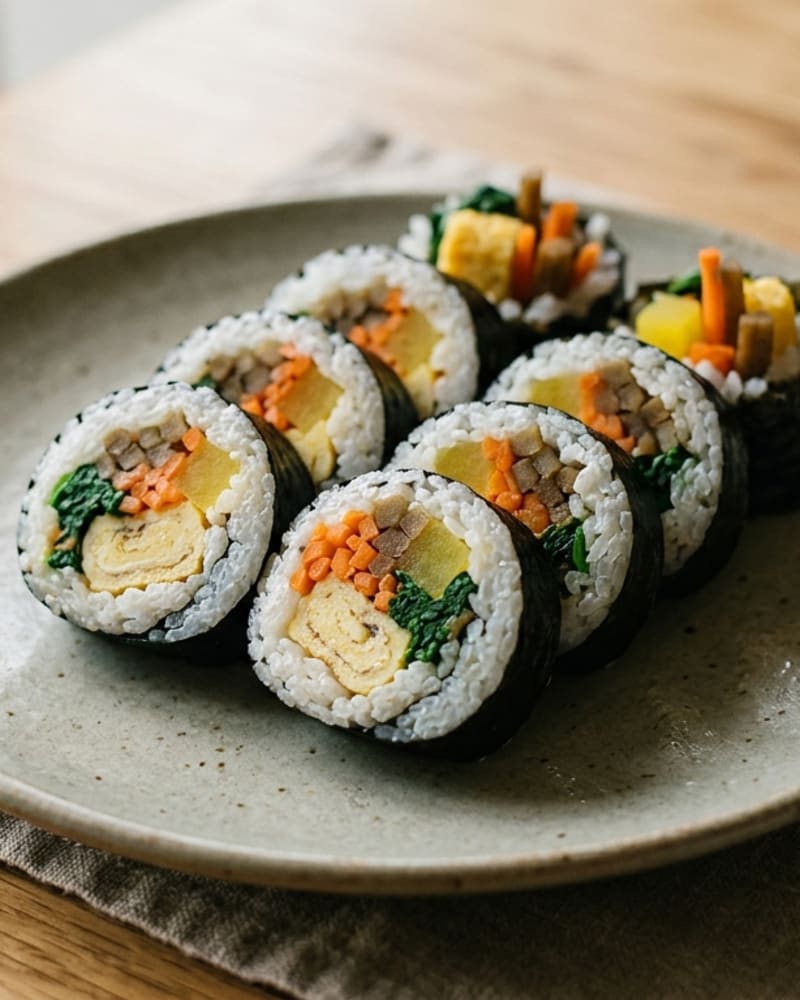
Ten past ten on a Saturday morning, the picnic is at noon, and the rice cooker clicks over to warm just as you finish slicing the carrot. This gimbap recipe, the one you swiped right on, takes 87 minutes from first rinse to last slice. Bring it to a first-date picnic and watch them quietly recalculate everything they assumed about you.
Eight rolls, one sticky rice, and a spiral of color you cut open yourself.
A good part of those 87 minutes is rice and waiting, not rolling. The rice cooks for about twenty minutes, the carrot, radish and ham take about five minutes to cut, and the egg and spinach each take a few minutes at the stove. Then it is a rhythm: lay the nori down, spread the rice thin, line up the fillings, roll tight.
You end up with eight rolls cut into six to eight rounds each, and each slice is a small cross-section that looks like you have a hobby.
What you need
- 2 cups short-grain rice
- 8 nori sheets
- 3 eggs
- 1 carrot
- 4 cups spinach
- 6 oz yellow pickled radish
- 6 oz deli ham
- 2 tbsp sesame oil
- 1 tbsp vegetable oil
- 1 tsp soy sauce
- 1 tbsp sesame seeds
- 1 tsp salt
How to make it
- Rinse 2 cups short-grain rice until the water runs mostly clear, then cook with 2.25 cups water according to your rice cooker or stovetop method (about 20 minutes). Julienne 1 carrot and 6 oz yellow pickled radish, and slice 6 oz deli ham into long strips (about 5 minutes).
- While the rice cooks, whisk 3 eggs with a pinch of salt. Heat 1 tbsp vegetable oil in a nonstick pan over medium heat and cook the eggs into a thin omelet, about 2 minutes per side. Slice the omelet into long strips.
- Blanch 4 cups spinach in boiling water for 30 seconds, drain, rinse under cold water, squeeze dry, and toss with 1 tsp soy sauce and 1 tsp sesame oil.
- When the rice is done, fluff it and gently mix in 1 tbsp plus 2 tsp sesame oil, salt to taste, and 1 tbsp sesame seeds. Let it cool until warm, not steaming hot.
- Lay 1 nori sheet shiny side down. Spread a thin, even layer of seasoned rice over about three-quarters of the sheet, leaving a bare strip at the top.
- Across the center, line up strips of egg, carrot, spinach, pickled radish, and ham. Roll tightly from the filled edge, wetting the bare nori strip to seal.
- Repeat with the remaining 7 nori sheets. Brush the rolls lightly with the remaining sesame oil, slice into 6 to 8 pieces each with a sharp wet knife, and serve.
Notes
Cooked leftovers of this gimbap recipe keep three to four days refrigerated, per USDA FSIS. Wrap the rolls whole and slice them just before eating so the edges stay tidy.
Rice is seasoned with sesame oil, salt and sesame seeds rather than vinegar, so gimbap tastes nutty and savory where sushi tastes sharp. It also means the rice should be tasted before it is rolled, because a roll that is under-seasoned stays under-seasoned all the way through.
Rinse the rice until the water runs mostly clear, then cook it with 2.25 cups water to 2 cups rice. Short-grain rice is the one that sticks to itself, and that stickiness is what holds the roll together from the inside.
The spinach gets thirty seconds in boiling water, a cold rinse and a hard squeeze. Squeeze until it feels almost dry, because the water you leave in has nowhere to go except into the rice and the nori.
The egg is cooked as a thin omelet, about two minutes a side, then sliced into long strips. Thin is the point, because a thick omelet will not curve with the roll and the whole thing ends up lumpy.
Your agent shops one carrot, one pack of pickled radish and a pack of nori. You are not wandering the Korean aisle with a list in the back of your head, and a leftover pack of seaweed turns into a good snack on its own.
Swaps that actually work
The short-grain rice is the point of this gimbap recipe. It is what makes the roll hold, and long-grain rice will not stick together or slice cleanly. Fillings, though, are like options in your swipe stack: nearly any of them can be replaced, as long as the sticky rice stays.
Leave out the ham for a version without meat, and add more egg or strips of firm tofu cooked until they are browned. The roll will look the same and it will not feel like anything is missing.
Pickled cucumber or any crunchy pickle can stand in for the yellow pickled radish. It will not have the same color or sweetness, and a little extra bite helps against the rich egg and the sesame oil.
Cucumber, bell pepper or cooked burdock can stand in for the carrot or the spinach. Whatever you pick, cut it into long thin strips, because a chunky filling makes the roll bulge and tear.
Toasted sesame oil is what gives the rice its smell, so do not swap it for a neutral oil in the rice. It is the finishing touch on the outside of the roll too.
The swap that costs you the dish is skipping the squeeze on the spinach. Wet filling sends moisture into the rice, and a soggy roll is hard to rescue.
If it goes wrong
The roll splits when you slice it. It was rolled loosely or the knife was dry. Roll tighter, pressing the filling in as you go, and slice with a sharp knife that you wet between cuts.
The nori tears. The rice was too hot, or the sheet was overloaded. Wait until the rice is warm, not steaming, and if a tear happens anyway, press a spare scrap of nori over it with a dab of water.
The slices are bland. The rice was under-seasoned. Salt to taste when you mix in the sesame oil and seeds, and a small dab of soy on the spinach brightens the filling too.
It looks like a stuffed burrito. Overfilling is the gimbap version of trying too hard on a first date. Pare each filling down to a thin line, leave the bare strip at the top, and let restraint do the flirting.
The filling slides out of the ends. The strips were cut too short or not lined up across the center. Cut them the full width of the nori and keep them in a tidy bundle as you roll.
What to serve with it
The default is the rolls on their own, sliced and eaten with your hands.
The better version of the default is a small bowl of soy sauce on the side, or a few pieces of kimchi alongside, so each bite has something sharp next to it.
What in your fridge lifts it is anything cold and sour: a handful of sliced cucumber with a pinch of salt, or quick-pickled onion. A hot cup of tea works too, and so does a cold drink if the weather is warm.
It holds up as lunch the next day, wrapped whole.
Why this one earns its place
This gimbap recipe makes food you can eat standing up, on a blanket, or at your desk, and it does not need a plate or a fork. It also looks like it took more effort than it did, which is a pleasant surprise for whoever opens the container.
It is a dish that suits being swiped when the week has an outing in it. Your agent shops the rice, the nori and the fillings, and you keep the part where you roll it yourself.
For another way to pack ahead, see meal prep for the week. More Korean cooking that keeps its color: Korean beef bulgogi bowls, and beef galbi for the night you want something with a grill-side swagger.
More like this: all Korean recipes in Crave Corner.