Chicken Adobo With Garlic That Melts and a Sauce That Clings
Jump to recipe ↓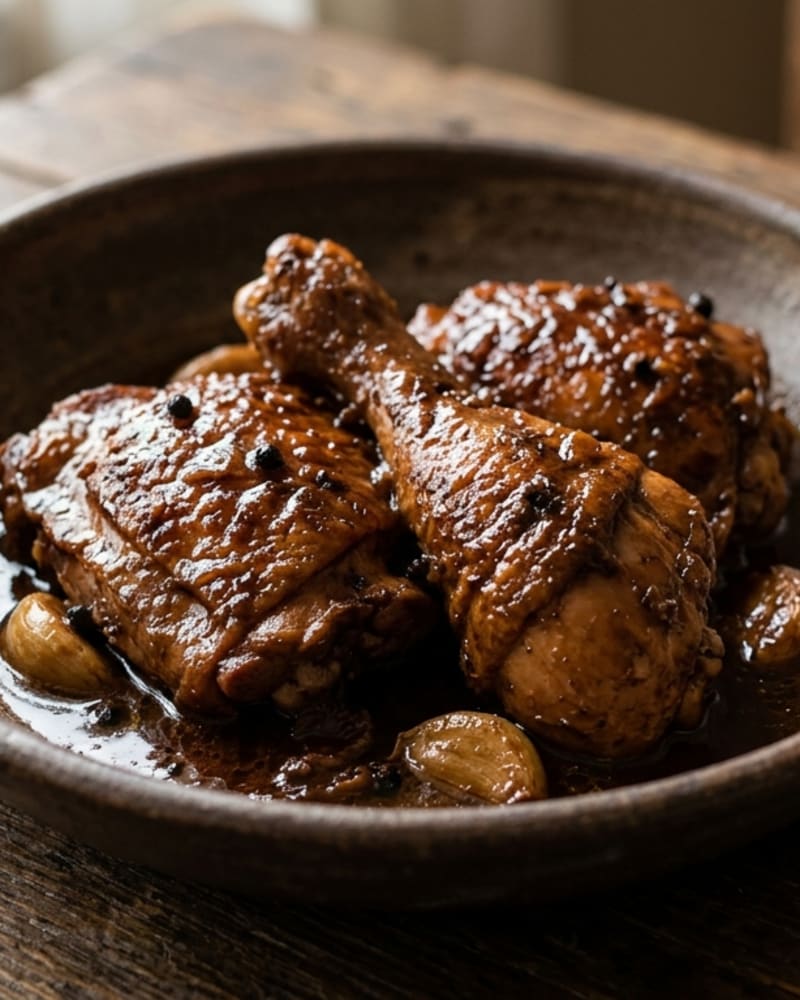
6:50 on a Thursday, eight cloves of garlic under the flat of your knife, and a pot that is about to make the whole building ask what is for dinner. This chicken adobo is vinegar, garlic and bay leaf doing what they do best: a braise that takes about 65 minutes and smells like a decision you made on purpose. Garlic this committed is a lot to ask of a first date, which is why you cook it for someone who is staying.
Brown it hard, braise it low, then take the lid off and let the sauce finish the job.
The shape of adobo is simple. You brown the thighs, add the garlic, onion, vinegar, broth, fish sauce, bay leaves and peppercorns, and let the pot do the rest while you cook the riced cauliflower that goes underneath. The last uncovered 5 to 10 minutes are what turn a thin liquid into a sauce that clings.
What you need
- 2 lb chicken thighs
- ½ cups apple cider vinegar
- 8 garlic
- 3 bay leaf
- 1 yellow onion
- ½ cups chicken broth
- 2 tbsp fish sauce
- 1 tsp black peppercorn
- 1 tbsp olive oil
- 16 oz frozen riced cauliflower
- ½ tsp salt
- ½ tsp black pepper
How to make it
- Smash and peel 8 garlic cloves and slice 1 yellow onion into thick wedges, about 5 minutes.
- Pat 2 lb chicken thighs dry and season lightly with salt and black pepper to taste.
- Heat 1 tbsp olive oil in a large pot or Dutch oven over medium-high heat and brown the chicken for 3 to 4 minutes per side. Work in batches if needed.
- Add the smashed garlic, sliced onion, 0.5 cups apple cider vinegar, 0.5 cups chicken broth, 2 tbsp fish sauce, 3 bay leaves, and 1 tsp black peppercorns.
- Bring to a boil, then reduce heat to low, cover, and simmer for 30 to 35 minutes until the chicken is very tender.
- Uncover and simmer 5 to 10 minutes more to reduce the sauce slightly. Discard the bay leaves.
- Meanwhile, cook 16 oz frozen riced cauliflower according to package directions, about 5 to 7 minutes.
- Serve the chicken and sauce over the riced cauliflower.
Notes
Cooked leftovers keep three to four days refrigerated, per USDA FSIS. Store the chicken with its sauce so it stays moist.
Day two is something to look forward to with chicken adobo: the sauce has had the whole night to settle into the meat, and the sharpness of the vinegar rounds out. Reheat gently, covered, with a splash of water if the sauce has tightened. It can be frozen in its sauce, and should be thawed in the fridge before it goes back on the stove.
The recipe uses a large pot or Dutch oven, with a lid. Brown the thighs in batches if they do not fit in a single layer, because crowded chicken steams instead of browning, and the browning is where the depth in the sauce starts.
Poultry should reach 165°F per USDA, which a long braise will pass by a wide margin. The better test here is texture: after 30 to 35 minutes the chicken should be very tender and pull apart at the touch of a fork.
The peppercorns are whole, and they stay whole. One will turn up in a spoonful and bite back, and parking it on the rim of the bowl is perfectly polite.
Somewhere in your SwipeCart stack, a pot that makes the kitchen smell this good is the dinner equivalent of a profile photo with a dog in it. It does the work before you open your mouth.
One practical note on timing: the prep in the method is quick, about 5 minutes for smashing the garlic and cutting the onion, and then most of the clock is the pot working by itself. That is the window for the cauliflower, which the method starts toward the end so it lands on the plate hot. Smash the garlic cloves with the flat of the knife, peel them, and leave them whole. They soften in the braise until you can press one against the side of the bowl and eat it like a spread.
Swaps that actually work
The vinegar and the garlic are the point of chicken adobo. Adobo is a sour, savory, garlicky braise, and the 8 cloves are not a typo. If you are tempted to cut the garlic, cut the onion instead.
This version gets most of its salt from fish sauce. Many adobo recipes use soy sauce instead, and it can stand in for the fish sauce if that is what you have. Start with the same amount, then taste at the end, because soy sauces vary in saltiness.
Apple cider vinegar can be replaced with white vinegar or rice vinegar, and a little more broth takes the edge off if it tastes too sharp. Drumsticks work in place of thighs. Breasts will dry out in a braise this long, so they are the swap to avoid.
The riced cauliflower is the base in this version, cooked according to the package in 5 to 7 minutes, and white rice is the traditional partner for the sauce if you want something more filling. Either one gives the sauce somewhere to go.
The swap that costs you the dish is skipping the uncovered finish. Without it, you have chicken in a thin broth instead of chicken in a sauce that coats the spoon.
If it goes wrong
The sauce is too sharp. The vinegar has not mellowed yet. Simmer it uncovered a few more minutes, since the heat takes the edge off, and add a splash of broth if it is too strong.
The sauce is watery. The finish was too short. Keep simmering uncovered until it coats the back of a spoon, which can take the full 10 minutes.
It tastes flat. Salt. The fish sauce is the main salt in the braise, so taste the sauce at the end and add a little more fish sauce or a pinch of salt.
The chicken is pale. It went into the pot wet or the pot was crowded. Pat it dry next time and brown it in batches.
What to serve with it
Serve it in a shallow bowl with room for the sauce.
The default is the riced cauliflower in the recipe, which soaks up the sauce and keeps the plate light. On SwipeCart, choosing between cauliflower and white rice is the closest thing this dinner has to a second-date decision: both are good company, but only one is staying for the sauce.
The better version is steamed white rice, since the sauce deserves something that holds it in each spoonful. A pile of blanched green beans or sautéed bok choy beside it takes care of the vegetable.
The thing in the fridge that lifts it is sliced scallions or a few slices of fresh chili on top, which add freshness against the richness.
It makes a very good lunch the next day, reheated in a bowl with extra sauce spooned over.
Why this one earns its place
A dish with eight cloves of garlic is a statement, and chicken adobo makes its case without raising its voice. It cooks mostly unattended, and it is the kind of dinner that lets you say you made something from scratch without having stood over it.
Swipe it into the week and the agent can shop the thighs, garlic, vinegar and fish sauce in one pass. For more along these lines, chicken teriyaki is another sweet-salty weeknight chicken, cauliflower fried rice is a good home for leftover riced cauliflower, and how to shop for a new recipe helps when the fish sauce is not in your pantry yet.
More like this: all Filipino recipes in Crave Corner.