Kibbeh With a Crackling Shell That Holds Together in the Oil
Jump to recipe ↓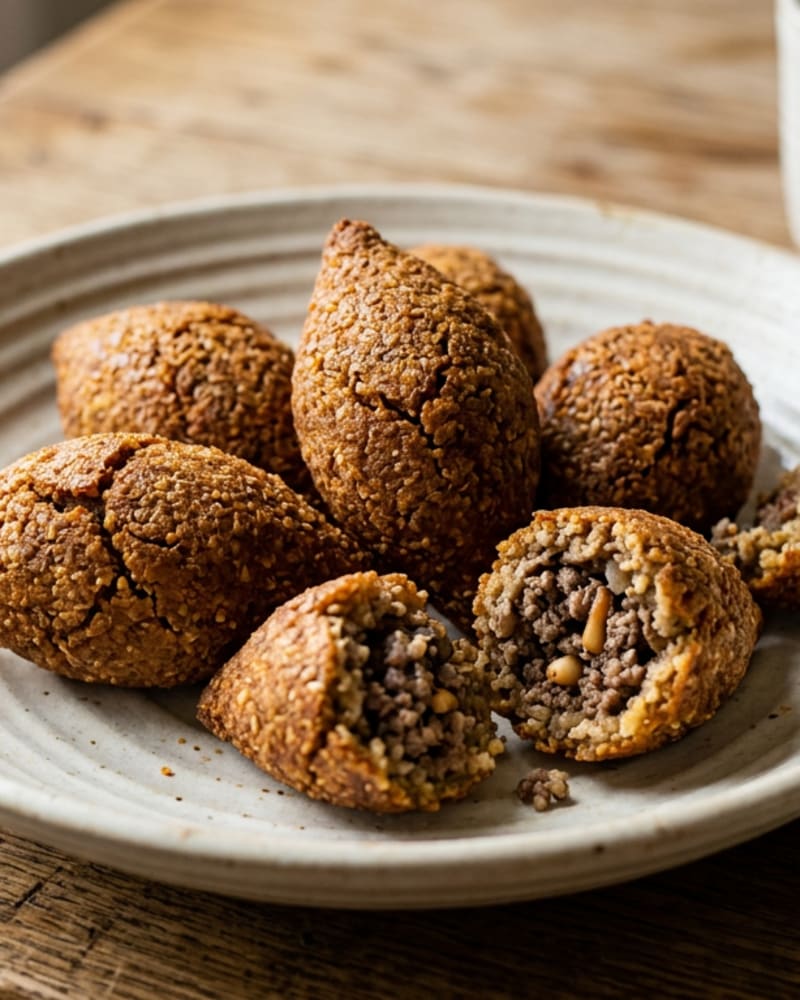
About 480 calories per serving, estimated from the ingredient list.
Sunday, 4:00, a bowl of bulgur soaking on the counter and a pound of ground beef waiting beside it. This kibbeh recipe takes about fifty minutes, twenty of which are the bulgur sitting in water while you do something else, and it ends with a plate of deep brown, crackling footballs. Fry them with the window open and the neighbors start finding reasons to knock. You swiped right on it Friday, the agent tracked down the bulgur, and all that is left is to act like you have always made this.
Small, tight and fried at a steady 350°F is the whole game.
Small, because anything bigger than an egg goes dark outside before the middle cooks through in six minutes. Tight, because a mixture kneaded until it holds together like dough seals into one smooth shell instead of cracking along the seams. Steady, because oil that dips below 350°F soaks into the shell instead of sealing it, and you get greasy, cracked kibbeh.
Kibbeh is widely considered a national dish of Lebanon and is a staple across the Levant, and the versions there often wrap a separate spiced filling in a shell of meat and bulgur. This one takes the shortcut: the beef, bulgur, onion and allspice become a single mixture, shaped around a few pine nuts.
What you need
- 1 lb ground beef
- 1 cup bulgur wheat
- 1 onion
- ¼ cup pine nuts
- 1 tsp allspice
- 4 cups vegetable oil
- 1½ tsp salt
- ½ tsp black pepper
How to make it
- Soak 1 cup bulgur wheat in water for 20 minutes then drain well.
- Finely mince the 1 onion about 5 minutes.
- Mix ground beef with drained bulgur, minced onion, 1 tsp allspice, 1.5 tsp salt and 0.5 tsp black pepper.
- Shape the mixture into small football shapes and stuff each with a few pine nuts.
- Heat 4 cups vegetable oil in a deep pot to 350F.
- Fry the kibbeh in batches until deep brown and crispy, 6 minutes each batch.
- Drain on paper towels and serve hot.
Notes
Cooked leftovers keep three to four days refrigerated, per USDA FSIS. Store them in a container with a paper towel underneath to catch condensation.
Reheat in a hot oven or an air fryer rather than the microwave. The microwave turns the crust soft and chewy; dry heat brings most of the crunch back in a few minutes.
Kibbeh freezes very well before frying, which is the real reason to double this kibbeh recipe. Shape them, freeze them on a tray until solid, then bag them. Fry them straight from frozen in the same 350°F oil, giving them a little longer, and check that the center reaches 160°F, the USDA safe minimum for ground beef.
Mince the onion as finely as you can, almost to a paste. Big pieces of onion create weak spots where the shell cracks open, and they release water into the mixture as it sits.
Knead the mixture longer than feels necessary, a good two or three minutes. This is not the moment to play it cool. The bulgur and meat need to bind into something closer to a dough than a meatball mix. If it crumbles when you shape it, keep working it with damp hands.
Shape with slightly wet hands. Hold a ball of the mixture in one palm, press a hollow into it with your finger, drop in a few pine nuts, and close it up into a point at each end.
Swaps that actually work
The bulgur is the point of any kibbeh recipe. It is what gives kibbeh its distinctive nubbly, crisp crust, and there is no swap for it in this version. If you can find fine bulgur, often sold as #1, use it; it binds better and needs less soaking. Coarse bulgur works but makes a rougher shell, so pulse the finished mixture briefly in a food processor to tighten it.
Lamb, or half lamb and half beef, is the more traditional meat in an older kibbeh recipe and gives a richer, slightly gamier result. Use it in exactly the same quantity.
Allspice carries the flavor here. If you have Lebanese seven-spice or baharat, it makes a lovely swap. A small pinch of cinnamon alongside the allspice also works. Do not skip the spice entirely, because what is left tastes like a fried meatball.
Pine nuts are pricey and sometimes missing from the shelf, which is a rude way to get stood up. Slivered almonds or chopped walnuts do the same job of a crunchy, buttery center.
Any neutral, high-smoke-point oil works for frying: vegetable, canola or peanut. Extra virgin olive oil is costly at four cups and its flavor competes with the allspice, so save it for the salad.
You can bake them on an oiled tray instead of frying, brushed with oil. They come out drier and paler, with less of the crackle, but they are still worth eating.
If it goes wrong
They burst open in the oil. The mixture was too wet, so steam forced its way out through the shell. Lift out the broken ones, press the remaining mixture in a fine sieve with the back of a spoon or wring it in a clean kitchen towel, re-shape, and carry on with the next batch.
They are greasy. The oil dropped below temperature, usually from crowding the pot. Crowding is the kitchen version of swiping right on everyone at once: nobody gets your full attention, and every one of them ends up disappointed. Fry fewer at a time and wait for the thermometer to recover between batches.
The outside is dark but the middle is raw. They are too large for the oil to cook through in six minutes. Finish the undercooked ones on a tray in a hot oven until the center hits 160°F, and shape the rest smaller.
They taste flat. Most likely salt. Before you shape the whole batch, fry one small spoonful of the mixture, taste it, and adjust the salt and allspice in the bowl. It costs two minutes and saves the whole plate.
What to serve with it
The default is plain yogurt with a little grated garlic and salt stirred through, for dipping. It is simple and right, the kind of plus-one that makes the kibbeh look good and never tries to steal the conversation.
The better version of the default adds a sharp salad: chopped cucumber, tomato and parsley with lemon and olive oil, or a proper tabbouleh if you have the bulgur left over.
The thing in the fridge that lifts it is pickles. Pickled turnips are traditional, but any sharp pickle or a few lemon wedges cut through the richness of the fried shell.
Warm pita turns a plate of kibbeh into a full dinner.
Why this one earns its place
It is the kind of dish people assume you ordered in. Eight ingredients, most of them pantry staples, and the most technical thing this kibbeh recipe asks of you is a thermometer clipped to the side of the pot.
It also rewards a double batch, which mostly means more time at the shaping stage with damp hands. A bag of shaped kibbeh in the freezer is a dinner that needs nothing but hot oil and yogurt. Swipe it in when you have a slow Sunday, and let the agent find the bulgur and pine nuts so you are not hunting the international aisle yourself.
If you want more from the same corner of the map, the shawarma plate uses the yogurt, salad and pita you just set out. For turning a frozen batch into a week of easy dinners, meal prep for the week lays out the system. And if bulgur and pine nuts are new to your list, how to shop for a new recipe covers where they tend to hide.
More like this: all Middle Eastern recipes in Crave Corner.