Jjajangmyeon With a Glossy Black Bean Sauce That Clings to the Noodles
Jump to recipe ↓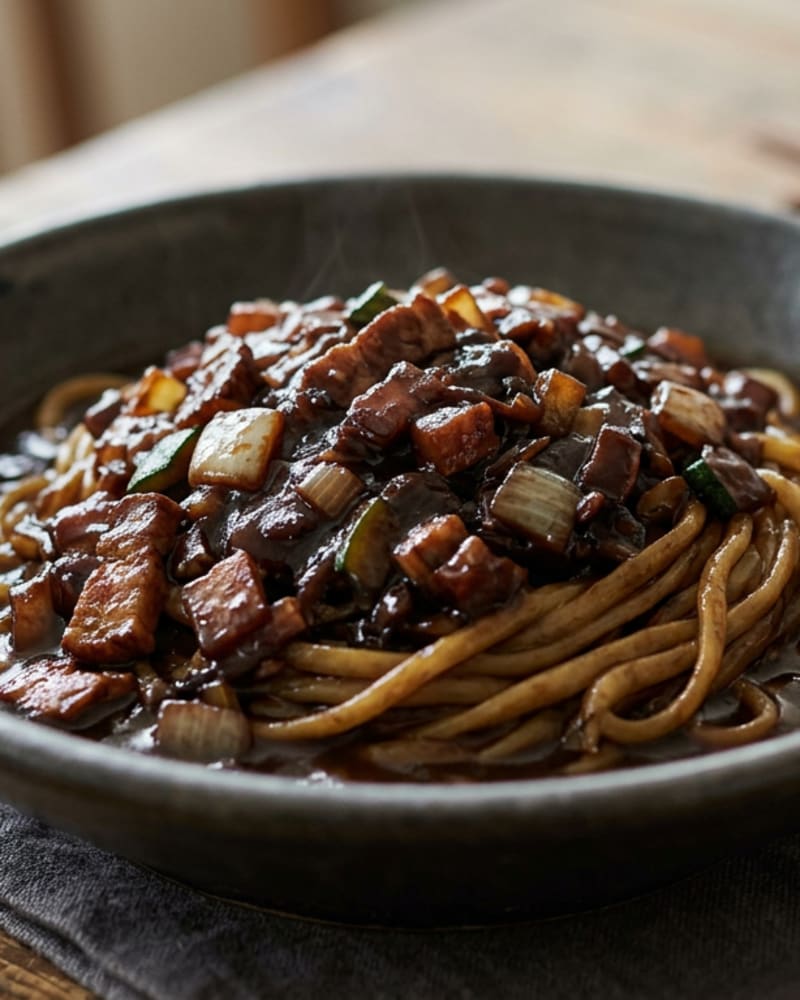
It is 8:05 on a Wednesday, the day has been the kind that deserves a dark, salty, slightly dramatic dinner, and the bowl in front of you is nearly black. Jjajangmyeon is thick black bean sauce over chewy wheat noodles, with pork and diced vegetables, and it asks for your full attention. Wear the dark shirt: this one clings, leaves marks, and is worth it.
Fry the black bean paste in oil first, and the whole bowl goes from flat to fragrant.
The sauce is built in one skillet. A half cup of black bean paste fries in 3 tablespoons of vegetable oil for 2 minutes, then the ground pork goes in, then the diced onion, potato, zucchini and cabbage. A cup and a half of water and a tablespoon of sugar bring it to a simmer for 8 minutes, and a cornstarch slurry finishes it glossy in 1 more minute. The noodles boil separately, the sauce goes over the top, and thin strips of cucumber land on the pile.
What you need
- 16 oz fresh wheat noodles
- ¾ lb ground pork
- ½ cup black bean paste
- 1 yellow onion
- 1 zucchini
- 1 potato
- 2 cups cabbage
- 3 tbsp vegetable oil
- 1 tbsp sugar
- 1 tbsp cornstarch
- ½ cucumber
- ½ tsp salt
- ¼ tsp black pepper
How to make it
- Dice 1 yellow onion, 1 zucchini, and 1 potato into 0.5-inch cubes, and chop 2 cups cabbage into bite-size pieces (about 8 minutes).
- Heat 3 tbsp vegetable oil in a large skillet over medium-high heat, then fry ½ cup black bean paste for 2 minutes, stirring until fragrant.
- Add 0.75 lb ground pork and cook for 4 to 5 minutes, breaking it up until no pink remains, then season with ½ tsp salt and ¼ tsp black pepper.
- Stir in the onion, potato, zucchini, and cabbage and cook for 6 to 8 minutes until the vegetables soften.
- Pour in 1.5 cups water, add 1 tbsp sugar, bring to a simmer, and cook for 8 minutes until the sauce thickens slightly.
- Stir 1 tbsp cornstarch with 2 tbsp cold water, pour it into the sauce, and simmer 1 more minute until glossy.
- Boil 16 oz fresh wheat noodles according to package directions (about 4 minutes), drain, and divide among bowls.
- Ladle the black bean sauce over the noodles and top with thin strips of 0.5 cucumber.
Notes
Stay near the pan, because jjajangmyeon likes an audience. The potato softens into the simmer and helps thicken the sauce, the cornstarch finishes the job, and the sugar keeps the salt from running the show. Taste at the end and the sauce should read deep and rounded rather than like salty paste on noodles.
Cut the vegetables to the 0.5-inch size the method asks for. The potato is the slowest to soften, so keep it at that size or smaller, and the onion, zucchini and cabbage will all arrive at tender together.
Black bean paste is salty, and brands differ. The method puts only ½ teaspoon of salt in with the pork, so taste the finished sauce before you reach for more.
Mix the cornstarch with 2 tablespoons of cold water before it goes into the sauce. Cold water keeps it smooth, and the sauce goes glossy in about a minute once it simmers.
The sauce is a good candidate for making ahead. It thickens in the fridge, so loosen it with a splash of water when you reheat, and warm it while the noodle water comes to a boil.
Cooked leftovers of jjajangmyeon keep three to four days refrigerated, per USDA FSIS. Store the sauce and the noodles in separate containers, because noodles that sit in sauce soak it up and go soft.
The cucumber is the cool, crisp counterpoint on top, and it is the only raw thing in the bowl. Cut it into thin strips just before serving so it stays fresh and bright against the hot sauce.
Swaps that actually work
The black bean paste is the point, so leave it alone. Look for a jar labeled as Korean black bean paste (chunjang), and know that a jar of black bean garlic sauce is a different product, and your jjajangmyeon will taste like it.
Ground beef or ground chicken can take the pork's place. Cook either one until no pink remains, and use a thermometer if you want certainty: ground beef 160°F, ground chicken 165°F.
Vegetables bend more than many dishes. Extra cabbage can cover for the zucchini, and extra onion can cover for the cabbage. Keep some onion in no matter what, because it melts into the sauce and gives it sweetness.
Noodles can move too. Dried udon, or thick spaghetti in a pinch, will hold the sauce. Cook whatever you use according to its package. If you call spaghetti "close enough," we respect the honesty.
Leave out the tablespoon of sugar and the sauce tastes like salt with a grudge. That is the swap that costs you the dish.
If it goes wrong
It is too salty. The paste was a salty brand, or extra salt went in on top. Loosen the sauce with a splash of water, simmer it a minute, and serve it over a little more noodle. The cucumber on top helps too.
The sauce is thin and watery. Your jjajangmyeon needed another minute with the cornstarch. Stir 1 tablespoon of cornstarch into 2 tablespoons of cold water, pour it in, and simmer 1 more minute until it turns glossy.
It tastes sharp, bitter or flat. The paste did not get its full 2 minutes in the oil, or the sauce did not simmer long enough. Keep the sauce at a simmer for a few more minutes, and add a small pinch more sugar if it still tastes sharp.
The potato is still firm. The cubes were bigger than 0.5 inch, or the heat was too low. Keep the sauce at a steady simmer until a fork goes through the largest cube.
What to serve with it
The default is just the bowl, since the noodles, the sauce and the cucumber already make a full meal. Set out the spoon and the chopsticks together, because a bowl of jjajangmyeon is best mixed from the bottom up, so every strand picks up its share of sauce before the first bite.
If you are cooking for someone you want to impress, this is a good one to put in the middle of the table. The sauce is dramatic, the noodles are friendly, and the whole thing says you are comfortable getting a little messy together.
The better version of the default is a sharp pickle on the side. Pickled yellow radish is a common pairing, and a small dish of raw onion for dipping is another.
The thing in the fridge that lifts it is kimchi, for a spicy, sour contrast against the sweet, savory sauce.
It works as lunch the next day: reheat the sauce with a splash of water, boil fresh noodles for about 4 minutes, and put it together again.
Why this one earns its place
Jjajangmyeon looks like a dish that took an evening, with a glossy black sauce and the kind of presence that makes a Wednesday feel like a date, but it is a single skillet and a pot of boiling water. It is comfort food for a bad day, and it does not ask you to explain yourself.
Swipe jjajangmyeon into your week and the agent can put the paste, the pork and the noodles on the cart.
For a few more noodle nights, try hoisin garlic noodles. If you want more Korean flavors, Korean beef bulgogi bowls is the next one. And for the evenings when the hardest part is choosing, decision fatigue and what to eat is worth a read.
More like this: all Korean recipes in Crave Corner.