Chicken Parmesan With a Crust That Survives the Sauce
Jump to recipe ↓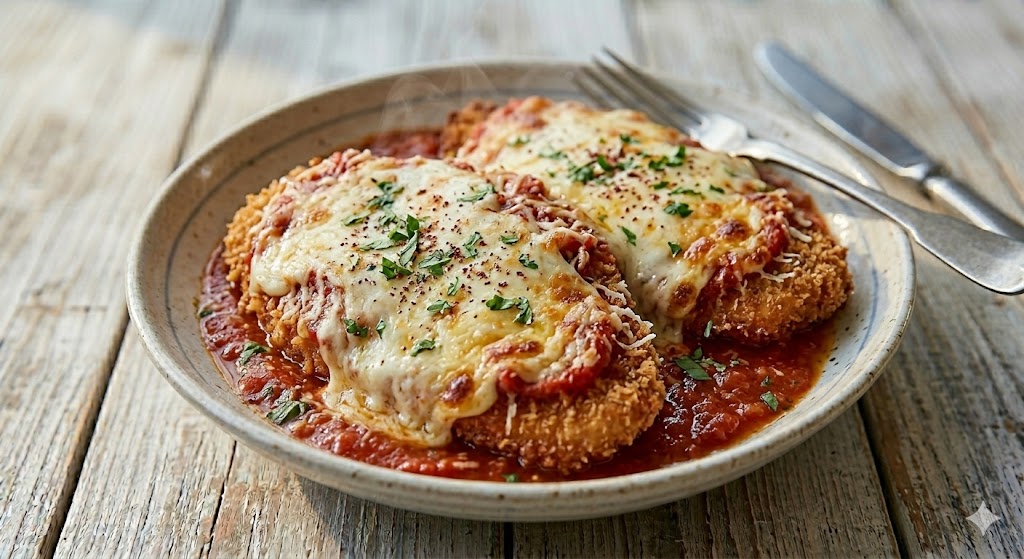
About 596 calories per serving, estimated from the ingredient list.
It is Friday, you want something that feels like a reward, and this chicken parmesan recipe takes forty minutes rather than the evening. It is also the dish most often ruined at the last step.
A crust drowned in sauce is not a crust, it is a wet coating.
The sauce goes in the middle of each cutlet and nowhere near the edges. That single decision is what leaves you with a rim of audible crunch after fifteen minutes in the oven, instead of the uniformly soft thing that most versions of this become.
What you need
- 4 chicken breasts, halved horizontally into cutlets
- 100g dried breadcrumbs, ideally panko
- 50g parmesan, finely grated
- 2 eggs, beaten
- 3 tbsp plain flour
- 400g passata or a simple tomato sauce
- 150g mozzarella, torn
- 4 tbsp olive oil, salt, black pepper, basil
How to make it
- Heat the oven to 200C fan.
- Bat the cutlets to an even thickness between two sheets of paper, about one centimetre, so they cook at the same rate.
- Set out three plates: seasoned flour, beaten egg, and the breadcrumbs mixed with the parmesan.
- Coat each cutlet in flour, then egg, then crumb, pressing the crumb on firmly so it holds.
- Fry in the olive oil over medium high heat, two to three minutes a side, until deep gold. Drain on a rack rather than paper so the underside stays crisp.
- Arrange in a dish, spoon sauce into the centre of each cutlet only, and top with torn mozzarella.
- Bake twelve to fifteen minutes, until the cheese is melted and blistered and the bare edges are still crunchy.
- Rest three minutes and finish with basil.
Notes
Cooked leftovers keep three to four days refrigerated, per USDA FSIS.
It reheats better than it has any right to, in a hot oven on a rack rather than in a dish, which lets air get underneath and revives the base. A microwave is the one thing that guarantees the crust never comes back.
The breaded, unfried cutlets freeze very well for three months, interleaved with greaseproof paper. Fry from frozen over slightly lower heat and add a couple of minutes a side. This is genuinely worth doing on a Sunday, because the breading is the only fiddly part of the whole recipe.
Batting the cutlets to an even thickness is the step people skip and then wonder why one end is dry. A breast is naturally wedge shaped, and without flattening, the thin end overcooks by several minutes before the thick end is safe.
The most common disappointment is breading that falls off in the pan. That is either a wet cutlet going into the flour, or not pressing the crumb on firmly enough. Pat the chicken dry first.
Use one hand for the wet plate and the other for the dry ones. Breading with two wet hands is how you end up with thick gloves of paste on your fingers and a thin patchy coating on the chicken, because the crumb sticks to you rather than to the cutlet. It sounds fussy and it takes one attempt to understand why every professional kitchen does it.
Drain on a wire rack rather than kitchen paper, without exception. Paper traps steam directly against the underside and softens the crust you just built, and it does it within about ninety seconds. If you have no rack, prop the cutlets against the side of a plate so air can circulate underneath them.
Swaps that actually work
The parmesan in the crumb is the point, and it is what separates this from a schnitzel with sauce on it. Grate it finely so it disappears into the breadcrumb rather than sitting on top and burning.
Panko is meaningfully better than fine dried breadcrumbs because the larger flakes stay open and crisp instead of packing into a dense shell. Ordinary breadcrumbs work; the result is just less dramatic.
The sauce can be anything decent, including passata warmed with garlic and salt. A long simmered ragu is wasted here, because it is only in contact with the crust for fifteen minutes.
Mozzarella can be provolone, fontina, or any melting cheese. Fresh mozzarella needs draining and tearing rather than slicing, or it releases water directly onto your crust.
The swap that costs you the dish is baking the cutlets instead of frying them. Oven breading browns unevenly and never develops the same texture, and at that point the whole architecture stops working.
If it goes wrong
The crust went soft. Too much sauce, or it covered the edges. Sauce the centre only, and take it out as soon as the cheese has melted.
The breading fell off. The chicken was wet, or the crumb was not pressed on. Dry the cutlets, and press firmly with the flat of your hand.
The middle is pink but the crust is dark. The cutlets were too thick. Bat them thinner, and remember the oven finishes the job.
It is flat. Salt, in the flour and on the chicken before breading. Seasoning only the sauce leaves the meat itself tasting of nothing.
What to serve with it
The default is spaghetti with a little of the same sauce, served alongside rather than underneath so the crust is not sitting in anything.
The better version of the default is a sharply dressed green salad and bread, which sounds lighter than it is and works considerably better against something this rich.
The thing in the fridge that lifts it is a squeeze of lemon over the bare edge of the crust just before eating. It cuts the fat and wakes up the parmesan.
Serve it the moment it comes out of the oven. Every minute it sits in a warm dish is a minute the steam coming off the sauce spends working against the crust you protected, and there is no way to recover it once it has gone.
It makes a very good next day sandwich, cold or reheated, pressed into a roll with the sauce.
Why this one earns its place
It is the dish that makes an ordinary chicken breast feel like a decision you made rather than one you settled for, and it does it with cupboard ingredients and forty minutes.
It also rewards the freezer trick more than almost anything else here. Bread twice as many cutlets as you need, freeze half raw, and a future version of you gets this on the table in twenty minutes on a night when that matters.
If chicken breast has become the thing you buy and then resent, quick weeknight dinner ideas has more ways out of it. For getting the breading step done once and eating from it twice, meal prep for the week. And weekly meal planning is how a Friday dish quietly becomes a Tuesday one.
More like this: all Italian recipes in Crave Corner.