Chicken Caesar Wrap That Does Not Go Limp by Lunchtime
Jump to recipe ↓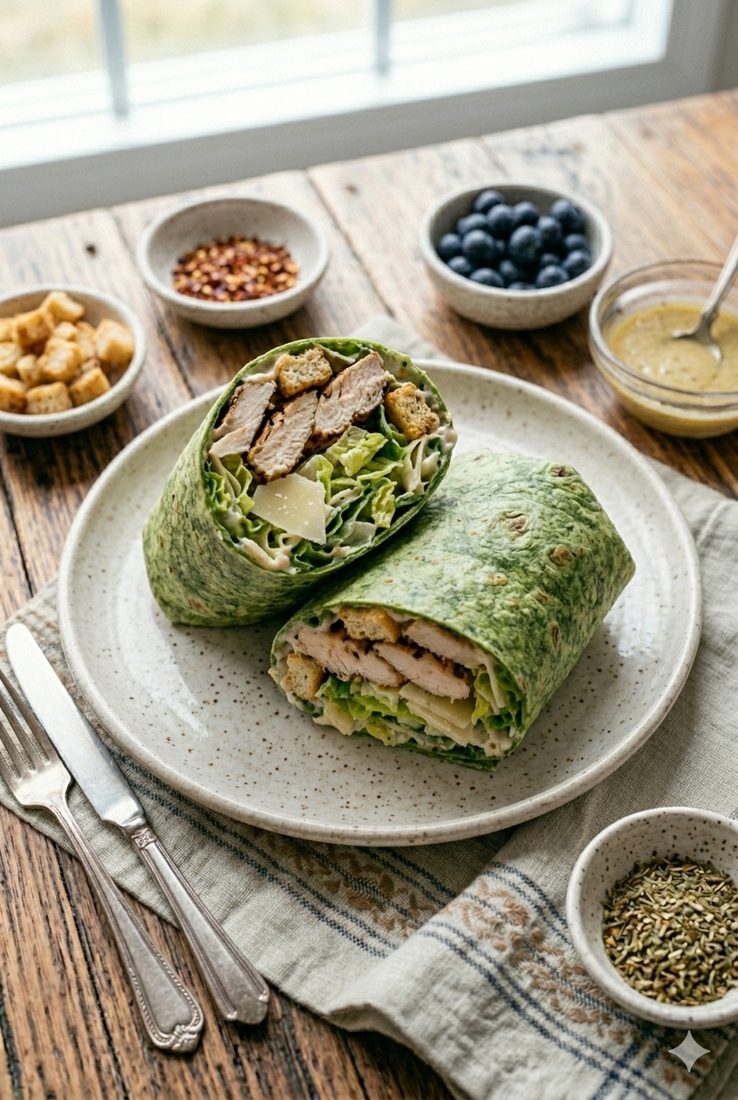
About 486 calories per serving, estimated from the ingredient list.
It is half past twelve, you are eating at your desk, and this chicken caesar wrap recipe exists because the thing you brought from home usually turns into a wet parcel by then. That is a construction problem rather than a recipe problem.
A wrap goes soggy from the inside, so the fix is the order you put things in.
Grated cheese against the tortilla, protein next, dressed leaves last and furthest from the wall. Dress the lettuce in a bowl so that no dressing ever touches the bread directly. Fifteen minutes of work and it holds until lunch instead of collapsing by eleven.
What you need
- 2 large flour tortillas
- 300g cooked chicken breast, sliced
- 1 heart romaine, shredded and dried properly
- 40g parmesan, grated, plus shavings
- 3 tbsp caesar dressing
- Black pepper, and lemon
How to make it
- Warm the tortillas for fifteen seconds a side in a dry pan so they fold without cracking.
- Dry the romaine properly in a salad spinner or a tea towel. Wet leaves are the whole problem.
- Toss the lettuce with the dressing in a bowl, not in the wrap, and only just before you build.
- Lay the grated parmesan down first, directly on the tortilla, as a dry barrier.
- Pile the chicken in a line slightly below centre, then the dressed lettuce on top of it, leaving a clear border.
- Fold the sides in, then roll tightly from the bottom, pressing as you go.
- Cut on the diagonal and eat, or wrap tightly in paper and it will hold four hours.
Notes
Assembled and wrapped tightly in greaseproof paper, this keeps about four hours at room temperature and a full day refrigerated, although the romaine gradually softens and the wrap is meaningfully better in the first few hours.
Cooked chicken keeps three to four days refrigerated, per USDA FSIS, so build from chicken you cooked inside that window rather than from the roast you are no longer sure about.
It does not freeze. Nothing in it survives freezing, and the tortilla in particular comes back as a damp sheet.
Wrap it in paper rather than foil or cling film if you are carrying it. Foil traps condensation against the tortilla, which is the same problem you just spent fifteen minutes engineering around.
The most common disappointment is a wrap that tastes rich but somehow bland. Caesar dressing is salty without being seasoning, and a wrap needs black pepper and a squeeze of lemon to taste like it was made rather than assembled.
Build it on the paper you intend to wrap it in. Rolling a wrap on a bare board and then transferring it to paper is how the seam opens, because you have to lift and reposition something that is only holding together under its own compression. Lay the paper down first, tortilla on top, and roll the two together in one movement.
Cut it on the diagonal rather than straight across, and only if you are eating it now. A cut wrap has two open faces and it dries from both of them, so anything travelling should stay whole until it arrives.
Swaps that actually work
The romaine is more of the point than people expect. It is one of very few lettuces sturdy enough to sit in dressing and still be crunchy an hour later, and little gem is the only straight substitute. Anything soft leaved turns to slime inside twenty minutes and there is no technique that prevents it.
The chicken can be anything already cooked. Leftover roast, poached breast, or a shop bought rotisserie bird pulled apart. This is one of the genuinely good uses for the last third of a roast chicken that nobody wants to eat as roast chicken again.
Caesar dressing from a jar is completely fine and needs no apology. If you are making it, keep it thicker than you would for a salad, because a thin dressing runs to the bottom of the wrap and pools.
Bacon is a legitimate addition and so is avocado, though avocado costs you most of the fridge life and turns the whole thing into a same day proposition.
The swap that costs you the dish is a cold tortilla straight from the packet. It cracks along the fold, and once the seam splits nothing holds.
If it goes wrong
It went soggy. Either the lettuce was wet or the dressing touched the tortilla. Spin the leaves properly dry and lay the grated parmesan down first as a barrier.
It unrolled. Not tight enough, or overfilled. Use less filling than feels generous and press as you roll rather than trying to compress it at the end.
The tortilla split along the fold. It was cold. Fifteen seconds a side in a dry pan and it becomes pliable.
It is flat. Salt, pepper and lemon. The dressing is carrying salt but not brightness, and a squeeze of lemon over the lettuce is what makes the difference.
What to serve with it
The default is nothing at all, because it is a complete lunch you can eat with one hand while doing something else.
The better version of the default is something sharp on the side to cut through the dressing. Cornichons, pickled onions or a few olives all reset the palate between bites of something quite rich.
The thing in the fridge that lifts it is any hot sauce, brushed very thinly onto the tortilla before the cheese goes down, where it seasons without adding moisture.
It is designed from the start to be a next day lunch, which is the entire reason for the layering order.
Why this one earns its place
It is the most reliable way to turn leftover chicken into something you actively look forward to at lunchtime, and it takes fifteen minutes the night before rather than any time at all on the day.
It also solves lunch, which is the meal most plans quietly ignore. Dinner gets planned and lunch gets bought, and the gap between those two facts is where a genuinely surprising amount of the weekly food budget disappears without anyone deciding to spend it.
If lunch is where the money leaks, average grocery budget for a family of four puts a real number on it. For making one roast chicken stretch across several days without anyone noticing, meal prep for the week. And meal planning and food waste is the argument for building the week around what is already in the fridge rather than around what looked good in the shop.
More like this: all American recipes in Crave Corner.