Carnitas Nachos With No Bare Chips and No Soggy Middle
Jump to recipe ↓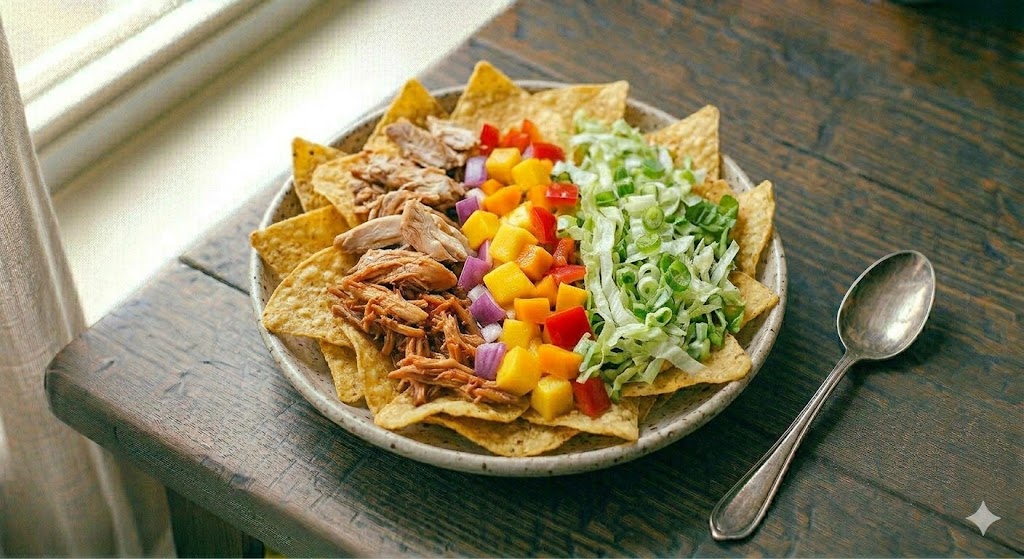
About 587 calories per serving, estimated from the ingredient list.
Friday night, people standing in the kitchen, and this carnitas nachos recipe takes twenty minutes if there is pork in the fridge already. It is the best thing you can do with leftover carnitas.
Nachos fail because people build them in a heap.
A deep pile melts on the surface and steams underneath, so you get a crust of cheese over a layer of warm, soft, naked chips. Two shallow layers on a wide tray means every chip is in contact with cheese and none of them are trapped under anything wet.
What you need
- 200g tortilla chips, the thickest you can find
- 400g cooked carnitas, crisped in a hot pan
- 250g cheddar or a melting cheese, grated
- 400g tin black beans, drained
- 2 jalapeños, sliced
- Soured cream, salsa, lime, coriander and spring onion to finish
How to make it
- Heat the oven to 200C fan.
- Crisp the carnitas in a hot dry pan for three minutes so the edges brown, and drain off the excess fat.
- Spread half the chips over a large tray in a single layer with almost no overlap.
- Scatter half the beans, half the pork and half the cheese, getting cheese onto as many individual chips as you can.
- Repeat with the second layer, finishing with the rest of the cheese and the jalapeños.
- Bake eight to ten minutes, until the cheese is fully melted and browning in places.
- Add the cold toppings only after it comes out, and eat it directly off the tray.
Notes
Nachos do not keep, and there is no polite version of that. Assembled and baked, they are excellent for about ten minutes and declining after twenty.
They do not reheat and they do not freeze.
What does keep is every component. Crisped carnitas, drained beans and grated cheese all sit happily in the fridge for three to four days per USDA FSIS, so the twenty minutes is genuinely twenty minutes on the night.
Use the thickest tortilla chips you can find. Thin restaurant style chips are pleasant to eat plain and structurally hopeless the moment anything warm lands on them.
The most common disappointment is a tray that is somehow both burnt and cold. That is one layer too deep and an oven too hot, and the fix is a wider tray rather than a longer bake.
Grate the cheese rather than buying it grated, for the same reason as the quesadillas. Bagged cheese is dusted with starch to stop it clumping in the packet, and that starch stops it flowing across the chips into a single sheet. It melts in isolated blobs instead, which defeats the entire two layer strategy.
Drain the pork after crisping. Carnitas comes out of a three hour braise carrying a lot of rendered fat, and fat that lands on tortilla chips does not evaporate in the oven. It pools. Ten seconds on kitchen paper is the difference between rich and greasy.
Use two trays rather than one if you are feeding four or more. It feels like more washing up and it is the single change most likely to fix a disappointing tray, because depth is the enemy here and surface area is the fix.
Swaps that actually work
The cheese is the point, structurally as much as anything. It needs to melt properly and it needs to be grated rather than sliced, because coverage matters more than quantity. Cheddar, monterey jack, or a mix all work.
The carnitas can be any cooked, shredded, crisped meat. Leftover roast chicken works. So does chorizo, which brings its own fat and needs no crisping step.
Beans are worth keeping even if you are inclined to skip them, because they give the tray some substance and stop it being pure fat and salt.
Jalapeños can be fresh or pickled. Pickled are better, because the vinegar cuts through everything else, and they can go on before baking without adding meaningful water.
The tray itself matters more than any ingredient on this list. A large flat baking sheet gives you the surface area the recipe depends on, while a deep roasting tin traps steam around the edges and guarantees the soft middle you are trying to avoid. Flat and wide beats deep and small every time.
The swap that costs you the dish is putting the cold toppings on before it bakes. Soured cream in a hot oven splits, and salsa releases water directly onto your chips.
If it goes wrong
The middle is soft and unmelted. Too deep. Two thin layers on a bigger tray, or two trays.
The chips are soggy. Wet toppings went on before baking, or the pork was not drained after crisping.
The cheese burnt before the middle melted. Oven too hot or the tray too near the top. Middle shelf, 200C fan, and watch it from eight minutes.
It is flat. Salt is rarely the problem here, since chips and cheese bring plenty. It is almost always acid. Lime over the top and pickled jalapeños fix a heavy tray.
What to serve with it
The default is soured cream, salsa and lime, put on after baking.
The better version of the default is guacamole made while the tray is in the oven, because it takes four minutes and it is the topping that most changes the result.
The thing in the fridge that lifts it is pickled onion, or any hot sauce with vinegar rather than just heat.
If you are feeding people who eat at different speeds, build two smaller trays and bake the second one ten minutes after the first. Nachos are at their best for a short window, and a second tray arriving hot is a considerably better experience than half a cold one going back in the oven.
There is no next day lunch here. Make the tray you intend to finish.
Why this one earns its place
It turns one component you already cooked into a meal that reads as an occasion, in twenty minutes, with no technique required beyond spreading things evenly.
It is also the most sociable thing in this section. Nachos go in the middle of the table and everyone eats off the same tray, which is a different kind of dinner from four plates and worth having in rotation for that reason alone.
If you cooked the pork on Sunday and are looking at it again on Wednesday, meal prep for the week is the argument for cooking components rather than meals. For keeping a Friday night in rather than ordering out, average grocery budget for a family of four puts a number on the difference. And quick weeknight dinner ideas has more in this range.
More like this: all Mexican recipes in Crave Corner.